


Over the past fifteen years, India has built one of the world’s most successful digital public infrastructures. Aadhaar, UPI, DigiLocker, the Account Aggregator framework and others created shared digital foundations on which governments, startups, and businesses have built thousands of digital services.
However, we are now in the midst of a major shift in computing. Over the last few years, AI systems have evolved from answering questions to completing increasingly sophisticated tasks. They can search for information, plan workflows, interact with software, generate code, and coordinate actions across multiple systems. As these capabilities mature, AI will become a persistent digital companion that works alongside people rather than simply responding to prompts.
For citizens, this shift has the potential to simplify everyday life.
Imagine an elderly citizen asking her agent to arrange transport to a hospital, retrieve medical records from DigiLocker, and share them with a doctor before an appointment. Or a farmer asking an agent to monitor government schemes, prepare subsidy applications, and notify them whenever new benefits become available. A small business owner could automate recurring payments, GST filing, compliance reminders, and supplier comparisons. These agents can significantly reduce the friction of navigating digital services, letting people focus on the outcome they want to achieve while AI systems coordinate the details.
This opportunity is especially significant for India. Voice-first interfaces, multilingual AI, and agents that understand local context can make digital services accessible to millions of citizens who find today’s services difficult to navigate. As Digital Public Infrastructure reaches more people, agents can help ensure that every citizen benefits from it, regardless of their familiarity with technology.
However, making this vision a reality requires solving several fundamental challenges.
For AI agents to become the primary interface to digital services, five foundational challenges must be addressed: accessibility, authority, consent, trust, and AI safety. Every citizen should have access to an affordable, trusted digital agent that acts on their behalf, is available in their preferred language, and is usable regardless of geography, income, literacy, or technical expertise. Citizens must be able to securely delegate authority to these agents so they can perform tasks autonomously within clearly defined limits, while retaining granular control over the information agents can access, the services they can interact with, and the duration of that authority without repeated approvals. At the same time, governments, financial institutions, healthcare providers, and other service providers must be able to verify that an agent is legitimately authorized to act on behalf of a citizen and independently audit every delegated action. Finally, the ecosystem must ensure that AI agents operate safely and predictably, remain aligned with user intent, are resilient against misuse and manipulation, and can be held accountable when their actions have real-world consequences.
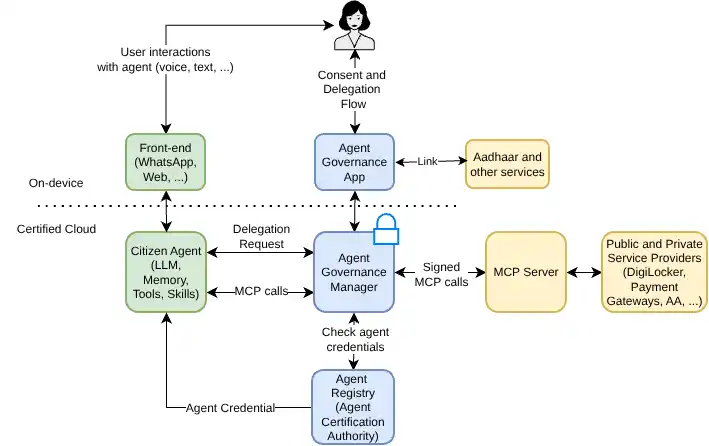
Figure 1. Doot Architecture. Citizens can delegate tasks to their agents hosted on device or cloud. Interactions between citizen agents and digital services are mediated by an Agent Governance Manager which is responsible for consent, delegation and agent governance.
Today, we are releasing Doot, an open architecture for citizen AI agents, and the Agent Consent and Delegation Protocol (ACDP), an open protocol that defines how delegated agent authority is represented, issued, validated, and revoked.
Doot envisions a world where every citizen can deploy one or more citizen agents that act on their behalf through certified agent operators. Unlike service agents, which represent service providers, citizen agents act solely in the interest of the individual. Certified agent operators may be public sector entities, such as municipalities or governments, or private sector entities, such as cloud providers, with citizen agents hosted either on-device or in the cloud. Citizens can configure, interact with, and delegate tasks to their agents through familiar interfaces such as WhatsApp or the web using voice or text in their preferred language.
Doot requires that any interaction between the agent and a digital service requires explicit consent for delegation obtained through a new class of entities called Agent Governance Managers (AGM). AGMs act as trusted intermediaries between citizens, their AI agents and the rest of the digital ecosystem. AGMs have a broader mandate beyond conventional consent managers; they are responsible for obtaining the citizen’s independent and explicit consent for delegation (through an AGM app on the citizen’s device), and authorizing every interaction between the agent and external services to ensure that the agent behavior is safe and within the bounded authority consented by the citizen. This separation creates a clear trust boundary. Agents focus on planning, reasoning and workflow management, whereas governance is handled by entities that can be independently audited, verified.
To enable interoperability across this ecosystem, Agent Governance Managers (AGMs) implement the Agent Consent and Delegation Protocol (ACDP), which defines how delegated authority is represented, issued, validated, revoked, and enforced. At the core of ACDP is the Agent Authorization Ticket (AAT), a portable, cryptographically verifiable authorization artifact that captures the authority delegated by a citizen to an agent. The AGM validates the AAT, verifies that the requested action falls within the delegated authority, and cryptographically binds this authorization to each downstream request. Downstream service providers (both public and private) trust the AGM as the authorization intermediary and verify that the request payload has been correctly signed by the AGM, allowing them to rely on a consistent, interoperable trust model while avoiding repeated authorization checks.
Trust also requires governance beyond technology. As part of the Doot architecture, we propose the Agent Certificate Authority (ACA) as an independent institution responsible for certifying AI agents and Agent Governance Managers, defining conformance standards, maintaining trusted registries, investigating security incidents, and revoking compromised or non-compliant participants. Much like institutions such as UIDAI and NPCI established trust in digital identity and payments, the ACA provides a governance framework that enables citizens, businesses, and public institutions to confidently adopt autonomous agents.
Although Doot is inspired by India’s Digital Public Infrastructure, its principles are broadly applicable. Every country will face similar questions as AI agents begin interacting with governments, financial systems, healthcare providers, and digital services. Open standards provide an opportunity for these ecosystems to evolve collaboratively rather than through fragmented, proprietary solutions.
We are releasing both Doot architecture and ACDP as open specifications because we believe the infrastructure governing AI agents should belong to the ecosystem rather than any single organization. Researchers, startups, governments, standards bodies, enterprises, financial institutions, cloud providers, and developers all have an important role to play in shaping how trusted AI becomes part of everyday life.
We invite the community to read the architecture, review the protocol, build implementations, challenge our assumptions, and contribute improvements. You can help by building AI agents. develop AGMs, integrating public and private services, strengthening the security model, and refining the governance framework. Help us evolve Doot into an open standard that enables trustworthy AI for everyone.